
Top 5 Medical Colleges in Uzbekistan for Indian Students (2026)
Quick Overview (Who This Post Is For)
- a shortlist of reputable, verifiable medical universities,
- fee ranges (not exact figures—because they change frequently),
- clarity on hostel availability and clinical exposure, and
- official ways to verify the university’s legitimacy.
Before You Choose: 3 Non-Negotiable Checks (NMC + WDOMS)
1) NEET (for students planning to return to India)
2) Check the university on WDOMS
3) Confirm program structure & internship/clinical training
Top 5 Medical Colleges in Uzbekistan for Indian Students
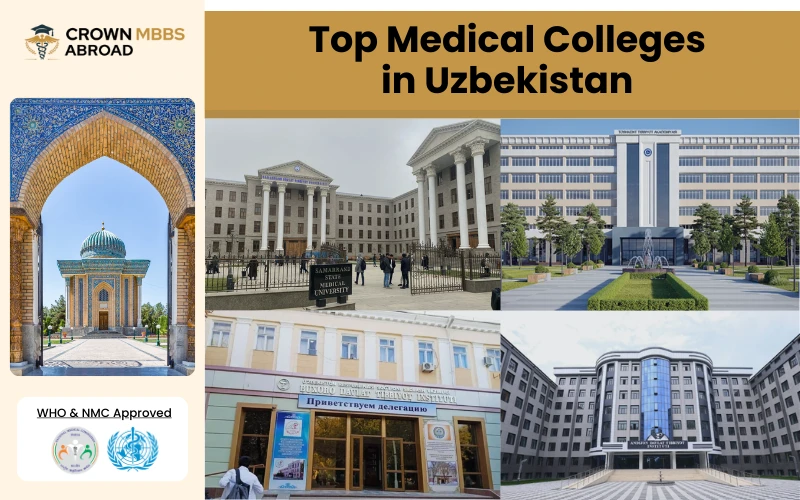
Below are the top 5 and most popular medical universities for mbbs in uzbekistan that are frequently discussed by international applicants and are verifiable through official channels (WDOMS + university sites). Each profile includes what Indian students usually want: fees (range positioning), hostels, and clinical advantages.
1) Tashkent Medical Academy

Why Indian Students Shortlist It?
- Located in the capital city (often better access to hospitals and a bigger medical ecosystem).
- Strong brand recognition in Uzbekistan’s medical education landscape.
- Easier access to embassies, international travel, and major city facilities.
Estimated Fee (Range)
- 1st Year Fees: USD 6,500 / INR 5,52,500
- 2nd–6th Year Fees: USD 4,600 / INR 3,91,000
- Total Course Fees: USD 29,500 / INR 25,07,500
Hostel & living
- Hostel availability may depend on intake volume.
- City living can be slightly higher than smaller towns, but with better connectivity.
Clinical Exposure
- University-linked hospitals and clinical training environment
- Opportunity for steady clinical observation in later years (verify how early postings begin).
2) Samarkand State Medical University (SamSMU) — Samarkand

Why Indian Students Shortlist It?
- Located in the capital city (often better access to hospitals and a bigger medical ecosystem).
- Strong brand recognition in Uzbekistan’s medical education landscape.
Estimated Fee (Range)
- Mid (varies by program and intake; confirm from official notices).
Hostel & living
- Hostel availability may depend on intake volume.
- City living can be slightly higher than smaller towns, but with better connectivity.
Clinical Exposure
- University-linked hospitals and clinical training environment
- Opportunity for steady clinical observation in later years (verify how early postings begin).
3) Bukhara State Medical Institute (BSMI) — Bukhara

Why Indian Students Shortlist It?
- Located in the capital city (often better access to hospitals and a bigger medical ecosystem).
- Strong brand recognition in Uzbekistan’s medical education landscape.
Estimated Fee (Range)
- Mid (varies by program and intake; confirm from official notices).
Hostel & living
- Hostel availability may depend on intake volume.
- City living can be slightly higher than smaller towns, but with better connectivity.
Clinical Exposure
- University-linked hospitals and clinical training environment
- Opportunity for steady clinical observation in later years (verify how early postings begin).
4) Andijan State Medical Institute (ASMI) — Andijan

Why Indian Students Shortlist It?
- Located in the capital city (often better access to hospitals and a bigger medical ecosystem).
- Strong brand recognition in Uzbekistan’s medical education landscape.
Estimated Fee (Range)
- Mid (varies by program and intake; confirm from official notices).
Hostel & living
- Hostel availability may depend on intake volume.
- City living can be slightly higher than smaller towns, but with better connectivity.
Clinical Exposure
- University-linked hospitals and clinical training environment
- Opportunity for steady clinical observation in later years (verify how early postings begin).
5) Fergana Medical Institute of Public Health — Fergana

Why Indian Students Shortlist It?
- Located in the capital city (often better access to hospitals and a bigger medical ecosystem).
- Strong brand recognition in Uzbekistan’s medical education landscape.
Estimated Fee (Range)
- Mid (varies by program and intake; confirm from official notices).
Hostel & living
- Hostel availability may depend on intake volume.
- City living can be slightly higher than smaller towns, but with better connectivity.
Clinical Exposure
- University-linked hospitals and clinical training environment
- Opportunity for steady clinical observation in later years (verify how early postings begin).
MBBS Fees in Uzbekistan (Estimated Range)
- Annual tuition: Low to Mid range.
- Hostel + living: Low to Mid range.
- One-time costs include insurance, documentation, and registration.
Hostel Reality Check (Must-Ask Questions)
- Is hostel accommodation guaranteed for first-year international students?
- What room-sharing options are available (double, triple, or four-sharing)?
- Is a mess facility available, specifically Indian food, or is self-cooking permitted?
- How is the hostel prepared for winter conditions (heating, hot water supply, and laundry facilities)?
- What is the distance from the hostel to the campus and hospital, and is it walkable or served by a shuttle?
- What security measures are in place (curfew rules, CCTV surveillance, and warden supervision)?
- What is the refund policy if hostel accommodation is not allotted?
Clinical Advantages in Uzbekistan (How to Evaluate Properly)
Quality of Clinical Exposure in Uzbekistan (What Students & Parents Should Know First)
- Clinical exposure is one of the most decisive factors in an MBBS abroad journey because it shapes a student’s real-world confidence, practical skills, and readiness for future licensing/exit exams.
- In Uzbekistan, most medical universities follow a structured medical education model where clinical learning increases year-by-year—starting with pre-clinical fundamentals (basic sciences) and gradually shifting into hospital-based learning in later years.
Clinical exposure is structured—but “hands-on level” can vary.
- Many universities provide clinical postings in affiliated hospitals, but the degree of direct patient interaction can differ based on:
- Early years are typically theory + labs, focusing on subjects like Anatomy, Physiology, Biochemistry, etc.
- Stronger and more frequent hospital exposure is typically seen in the clinical years, where rotations become a core part of learning.
Early years are typically theory + labs; serious clinical work comes later
- The first phase usually focuses on subjects like Anatomy, Physiology, Biochemistry, etc.
- Stronger and more frequent hospital exposure is typically seen in the clinical years (where rotations become a core part of learning).
Patient flow can be good, but supervision and teaching style matters
- Even with good patient volume, the learning quality depends on:
- whether faculty actively teach at bedside,
- whether case discussions are conducted,
- and whether students maintain logbooks and are assessed clinically.
Language is a real factor in clinical confidence
- Classroom teaching may be in English (depending on the program), but hospital communication can involve local languages.
- Students who proactively build basic medical communication skills tend to get more out of clinical postings.
Q: Are Uzbekistan medical colleges for MBBS recognized in India?
A: Yes, MBBS colleges in Uzbekistan are recognized in India, but don’t just trust “approved” claims. Always check the university on WDOMS and follow the latest NMC rules for foreign medical graduates.
Q: Are hostels and Indian food available for Indian students in Uzbekistan?
A: Hostels are usually available for Indian students in Uzbekistan, with food options ranging from hostel mess (where provided) to local restaurants or self-cooking if allowed.
Q: What are the NEET requirements for MBBS abroad?
A: NEET is required for admission to MBBS programs in India, but the specific requirements vary by country. For example, in Uzbekistan, NEET is required for admission to MBBS programs.